Why folded blankets look calm only when the shelf below is closed
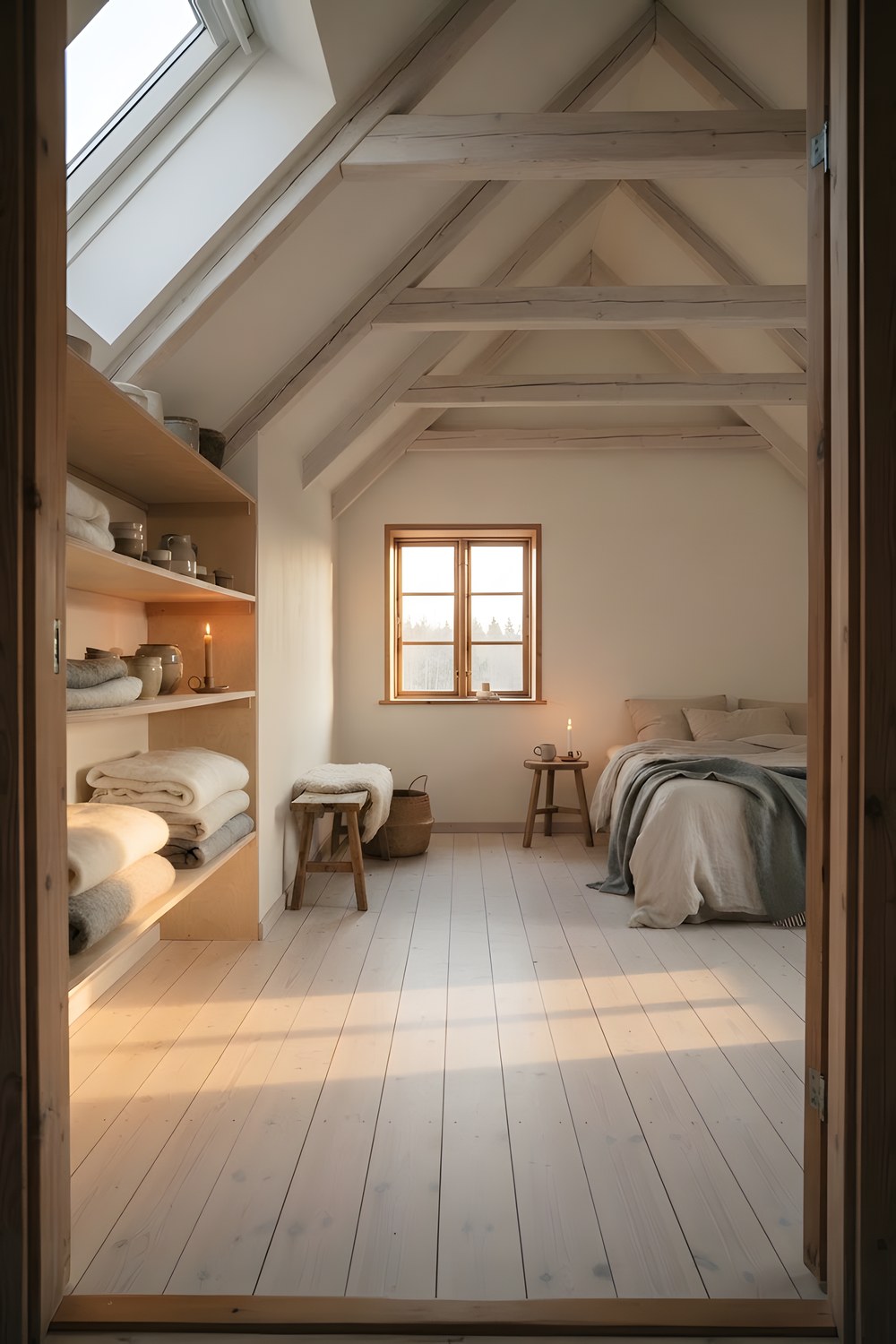
Open shelving reads as tidy only when the bulk of what a household owns is stored somewhere else. Here is why that trick works, and what it needs to keep working.
The shelf is a stage, not a warehouse
A sloped attic room with a few folded blankets on open shelving looks restful because so little is visible. That effect depends on a hidden rule: most textiles in a household are not on display at all. Wool throws, spare linen, off season quilts, they sit somewhere out of the light, and only a rotating handful ever reaches the shelf. The eye reads open storage as calm precisely because it is seeing a curated fraction, not an inventory.
Why we reach for a lid instead of a drawer
Think about what actually happens to a folded blanket over a season. It collects dust, it can pick up damp in an unheated attic corner, and wool in particular pulls in odors from a room. A closed container solves three problems a shelf cannot: it seals out dust and moths, it stacks so the floor space under a sloped ceiling is not wasted, and it lets you see the contents through a clear side without unstacking a pile to find the right blanket. That is why people keep a bin under the bed or against a knee wall even in a house that otherwise looks like nothing is stored at all. The visible shelf and the hidden bin are not opposites, they are a pair.
What the low ceiling changes
Attic storage has a specific constraint the picture hints at: headroom drops fast near the eaves. A tall stack of loose boxes gets awkward to reach in that zone, so households that store blankets and linens under a slope tend to favor flatter, foldable containers that collapse when empty and stand only as tall as needed when full. That single detail, low usable height, explains more about what gets bought for attic storage than any amount of styling advice.
The room in the picture works because the mess has a place to go that is not in frame.